
Vineyards of the Segura valley, Cieza.Nano Cañas / © ICEX

Murcia is an autonomous region consisting of a single province located in the southeast of Spain, on the Mediterranean coast. It has an area of 11,313.91 sq. kilometers / 4,368.3 sq. miles and a population of 1,474,449 inhabitants. Its capital city is Murcia.

Murcia's foremost agricultural crops include sweet fruits such as pears, early peaches, plums and table grapes and citrus fruits such as lemons, oranges and tangerines. Its most noteworthy vegetables are tomatoes, peppers, artichokes, potatoes and onions, which are eaten both fresh and tinned. The region is well known for its pimentón (a type of Spanish paprika).
Suckling pig is its main livestock produce. Sheep and goat farms are reserved for cheese making.
The fishing fleet in Murcia consists of over 215 vessels and catches reach 3,310 tons a year.
Murcia's most esteemed wines are of the red variety Monastrell. There are three Designations of Origin in the region, mostly using this variety: DO Jumilla, DO Yecla and DO Bullas.
Read more: Wines from Spain.

Murcia was visited by 583.062 foreign tourists in 2012.
The Salzillo Museum in Murcia houses important sculptures by the eighteenth-century sculptor of the same name.
In the region's second largest city, Cartagena, visits can be made to the interesting National Marine Archaeology Museum and the remains of the Roman amphitheater and theater.
Impressive castles watch over the Murcian towns of Moratalla, Jumilla, Mula, Aledo and Lorca. The latter also reveals some jewels of Baroque architecture in its many churches and mansions.
Sierra Espuña Nature Park is the most important environmental area in the region. And there are still virgin or almost-virgin spots along the coast, such as the Calblanque and Puntas de Calnegre Nature Parks, as well as the Salinas de San Pedro Nature Park, a necessary port-of-call for many flocks of migrating birds.
Rock Art of the Mediterranean Basin on the Iberian Peninsula have been listed by the UNESCO as World Heritage sites.
26 blue flags were awarded to beaches and 2 blue flags to marinas by the Foundation for Enviromental Education (FEE) in Murcia in 2012.
More info: Murcia Turismo.

Murcia is a Mediterranean region that still conserves aspects of its Muslim heritage, such as, among other things, an ancient irrigation system known as acequias. Caravaca de la Cruz is a landmark city of old churches crowned by a castle. The mineral-rich water of El Mar Menor, an inland sea, has been attracting tourists since the beginning of the twentieth century.
In Cartagena, a Mediterranean city with one of Spain’s busiest ports, the La Mar de Músicas Festival is held annually, with performances by groups and soloists from all over the world who bring musical creations halfway between tradition and the musical avant-garde. Other attractive summer events in the region of Murcia are the Festival de Cante de Lo Ferro and the prestigious Festival del Cante de las Minas de La Unión, both of which focus on flamenco, both singing and dancing.
Some world-famous Murcians include: the sculptor Francisco Salzillo (1707-1783); Juan de la Cierva (1895-1936), an aeronautical engineer who invented the autogiro; Isaac Peral (1851-1895), a scientist who invented a submarine for military use; and the classical guitarist, Narciso Yepes (1927-1997).
Fiestas
Holy Week in Lorca, where blue and white brotherhoods compete in pomp and ceremony during the Good Thursday and Good Friday processions.
The main festivities in the capital of Murcia called the Fiestas de Primavera are held just after Holy Week and offer parades with the focus on traditional life in the Murcian countryside and the delicious local products.

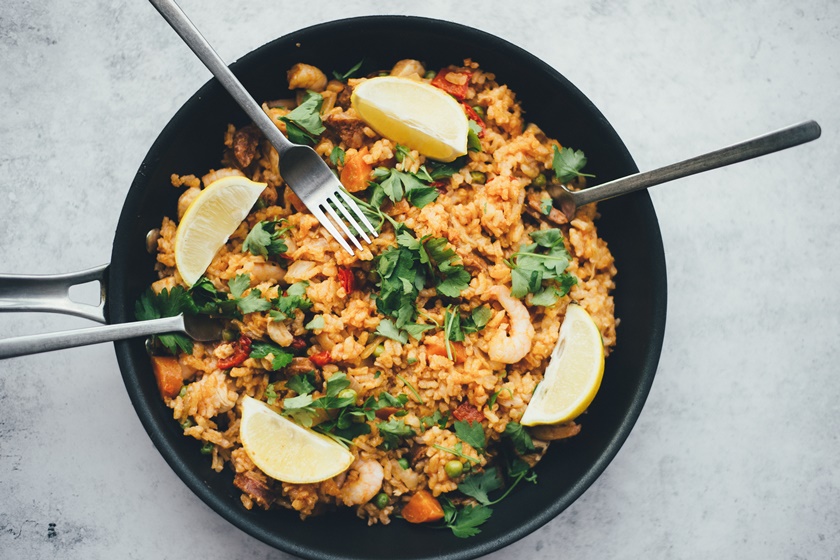
Murcia has developed a Mediterranean cuisine with excellent raw materials: inland horticulture provides broad beans, broccoli, artichokes or capers and the Mar Menor sea yields sea bream, sea bass and king prawns. Caldero, made of rice, fish and dried peppers called ñoras, is traditional fishermen's' fare.
Murcia's most typical dish is perhaps zarangollo, a combination of vegetables: usually zucchini, onions and eggs, cooked in olive oil. Rice appears in several traditional recipes such as rice broth with vegetables, rabbit and snails or rice with lean meat and ribs.
The region's most notable meat dishes include cutlets with cabañil garlic (a sauce made of garlic and vinegar) and lamb cutlets with dressing and bay leaves.
Murcian figs are a typical dessert.