
Gourmet Spanish Preserved Vegetables
Spreading The Word About Spanish Foods
Rather than having one national dish, Spain has a number of typically regional dishes whose fame has spread beyond the country's borders. These are paella, a rice dish from Valencia; gazpacho, the quintessentially Andalusian cold vegetable soup; and Spanish potato omelet, which is eaten all over the country in different guises.
Tapas are small portions of food served in Spanish bars to go with the drinks you order. This is a very general explanation, but the tapas term include a very wide variety of foods, from olives, potato chips and anchovies in vinegar to charcuterie slices, cheese, croquettes or shrimps. Any Spanish recipe can become a tapas speciality. It depends on the bar and the region you are visiting. For instance, in Madrid are very common the olives and pickles or the small bowls with the typical chickpeas and tripe stew.
The concept of paella is exported in different ways from Spain. There are companies that sell paella cooked and vacuum packed, or frozen and ready to be heated and eaten. Some companies also export kits with the various ingredients separately and with simple instructions on how to prepare this dish, as well as paelleras. You can find the different versions in supermarkets and gourmet food stores.
The pork culture in Spain dates back to a rural past in which a family's ability to survive depended largely on this animal. Early in the year, after having fattened the pig up over the previous twelve months, the family filled their pantry with various fresh and cured products from its slaughter, providing them with plenty of food for the coming months.
The process of converting Moorish territory on the Spanish mainland to Christianity in the Middle Ages made consuming pork a way of proving adherence to the Christian faith. It is said that the Spanish use every part of the pig, and this is certainly true. It is used to make sausages (chorizo, fresh and cured sausages, black sausage, etc.), the legs are dry-cured for ham, it provides steaks and chops, ribs, pork fat, and the snout, trotters and ears are eaten in various ways. Even the intestines are used for sausage casing. From this culture of need and making full use of resources came a real love of pork sausages.
Elvers are young eels and were traditionally used in the Rias (fjords) region of the Basque Country, although in the 20th century they became a delicacy enjoyed exclusively by the wealthier classes all over Spain. But over-fishing and high market prices make it increasingly difficult to find elvers on restaurant menus and cooked in the traditional way, with garlic and chilli.
Given the dish's popularity, the food industry created a surimi imitation product, which has become widely available under the name of "gula".
Visiting Seville is one of the best ways to get a taste of the Spanish tapas culture. Its bars offer a wide range of rations and tapas served with sherry, Málaga wine, Condado de Huelva wine or Montilla-Moriles. The most typical tapas are mojama (dried salted tuna), snails in a spicy sauce, shrimp crisps, ham and other Ibérico charcuterie, salt cod croquettes, fried fish, fried marinated dogfish, broad beans with ham, etc.
Spain has 17 regions, called Autonomous Communities. Some have a single province, such as Madrid or La Rioja, most have more, such as Extremadura (two), Aragon (three), Catalonia (four) and Andalusia (eight). There are two regions composed by islands: Canary Islands and Balearic Islands. Altogether, Spain has 52 provinces. Also part of Spain are two Autonomous Cities - Ceuta and Melilla, located on the north coast of Africa.
Travelling through Spain from north to south, we cross several rivers that flow across the Iberian Peninsula - the Ebro (the widest), Duero, Tagus (the longest), Guadiana and Guadalquivir. The most important in Galicia is the river Miño, which flows into the Atlantic Ocean, and, in the Cantabrian basin, the Nervión, Nalón and Narcea. Flowing into the Mediterranean are the Júcar, Turia and Segura. With the exception of the last stretch of the Guadalquivir, none of them are navigable.
All the guides are updated annually. Those available on the market include the Michelin Guide, the Gourmetour Guide and the Repsol Guide, all giving information on the best restaurants in Spain. The Guía Repsol is also published in English. Other guidebooks cover more specific subjects, such as Dónde comer bien en Madrid or Comer y beber en el Camino de Santiago.
Take a look at Books in the Foodpedia section, where you will also find a glossary of gastronomic terms in Spanish, the biographies of some Spanish chefs and other important names from the Spanish gastronomic scene, as well as useful Internet addresses on Spanish food products, etc.
This Spanish gastronomic jewel is obtained from Ibérico pigs, whose natural habitat is the dehesa, an ecosystem with holm and cork oaks, grasslands and shrubs. The jamón ibérico route crosses dehesa pasturelands, most of them in the province of Salamanca (Castile-León), Cáceres and Badajoz (Extremadura) and Huelva (Andalusia), all along a western strip in central and southern Spain.
|
This museum is located in the town of Burriana (Valencian Community).
|
|
The list of gastronomic events in Spain has lengthened over the last five years, but a number of them can be considered musts. Some examples are Madridfusión, Fórum Gastronomic, BCN Vanguardia and the National Pinchos and Tapas Competition in Valladolid (Castile-León).
The 2008 edition of the Michelin Guide gives information on over 2,300 restaurants in Spain, including about 130 tapas bars. In the hotels section, there is information on over 3,600 establishments.
New Basque Cuisine was a trend that first appeared in the mid-1970s and amounted to an adaptation to the province of Guipúzcoa (Basque Country) of a ground-breaking movement that was born in nearby France, the so-called Nouvelle Cuisine, led by chefs such as Michel Guérard and Paul Bocuse. About a dozen chefs in Guipúzcoa started to work simultaneously and almost spontaneously on an innovative concept - to bring traditional Basque cuisine and its products up to the high levels of cuisine in France. Many of the dishes they created during those years have today become classics, such as leek pastry, warm salads, peppers stuffed with salt cod, or scorpion fish loaf. The founders of New Basque Cuisine were Juan Mari Arzak and Pedro Subijana (together with the great maestro and teacher of teachers, Luis Irizar). It is not just by chance that both Arzak and Subijana continue to be amongst the leaders of the Spanish culinary avant-garde. New Basque Cuisine is considered the germ of contemporary Spanish cuisine.
The Spanish culinary avant-garde started out in the 1970s with a movement called New Basque Cuisine. It then gained international renown with Ferran Adrià when he was featured on the front page of the Sunday supplement of The New York Times in 2003. Ferran thus became the most prominent standard-bearer of Spanish gastronomy but he has always actively encouraged other Spanish chefs to stand alongside him in this cultural and social movement. Avant-garde cuisine already existed in Spain before Ferran, as in high Basque culinary circles, and will continue to exist after him. He has created a great following among younger generations of chefs who are keen to continue innovating, upholding the new image of Spanish cuisine. So what is it that defines 21st-century Spanish cuisine and what is the cause of its international success? Firstly, it is firmly rooted in Spanish regional and traditional cuisine, the basis for creativity. The chefs show maximum respect for local raw materials (although they are by no means against using products from other countries), their aim being always to bring out the food's flavor and natural properties; and they have extensive technical and scientific know-how which they put to good effect in their kitchens. Above all, there is great team spirit amongst Spanish chefs, leading to constant sharing of information and numerous culinary events all year round, such as Madridfusión and BCN Vanguardia.
There are seven Spanish chefs whose restaurants currently hold the highest distinction in this guide: Juan Mari Arzak and his restaurant in the Basque Country, Martín Berasategui (Basque Country, Carmen Ruscalleda and her Sant Pau (Catalonia), Pedro Subijana at his Akelarre (Basque Country), El Celler de Can Roca (Catalonia), Quique Dacosta Restaurant (Valencian Community) and Azurmendi (Basque Country).
Some of the traditional dishes in Spanish cuisine have been known for decades but it was only at the end of the 1990s that the media, food writers and gourmets in other countries turned their attention to Spain. The international media coverage achieved by the Spanish culinary avant-garde over the last 10 years, with Ferran Adrià at the head, came together with the economic, social and cultural development of Spain. This really took off at the end of the dictatorship of Francisco Franco (1939-1975) and the return of democracy. For much of the 40-year-long dictatorship, Spain was isolated internationally and suffered from economic autarchy, preventing it from keeping up with its developing neighbors. After the political transition to democracy and thorough reforms in all areas, Spain started to progress in education and the economy, and found its place on the international scene with landmarks such as its membership of the European Common Market in 1986, the Olympic Games in Barcelona and the Universal Exhibition in Seville in 1992, and its inclusion in 2005 amongst the top ten OECD economies. Only in a context of development like this was it possible to generate a cultural phenomenon such as that of the Spanish culinary avant-garde. Although Ferran Adrià and his front-page feature in the Sunday supplement of The New York Times in 2003 are considered the springboard for this movement, the real starting-point was New Basque Cuisine, a gastronomic trend that started up in the mid-1970s. This was when a group of young Basque chefs, including Pedro Subijana, Juan Mari Arzak and Luis Irízar, under the influence of Nouvelle Cuisine in nearby France, decided to inject Basque culinary traditions with new ideas.
Spain has one of the longest coastlines in Europe bordering the Mediterranean, the Atlantic Ocean and the Cantabrian Sea. It also has two important archipelagos - the Canary Islands and the Balearic Islands. Altogether, there are over 7,500 kilometers (4,660 miles) of coastline.
It is the second most mountainous country on the European continent, only beaten by Switzerland.
The escabeche technique is one of the most traditional in Spanish gastronomy. Introduced by the Moors during the time of Al-Ándalus (8th-15th centuries), it serves not only to preserve foods but also to give them a very special flavor. Escabeches were included in the Libro de Guisados, a cookery book written in 1520 by Ruperto de Nola, a chef in the Spanish court, who stated that this was a common technique at the time in the Iberian Peninsula. Basically, an escabeche is a sauce made from olive oil, vinegar, garlic, salt, bay leaf and pepper, with the possible addition of herbs such as oregano and thyme, or spices such as pimentón. The sauce is used for frying or stewing fish (sardines or tuna, or shellfish such as mussels), game (partridges, quails or rabbit) and poultry, such as chicken. The ingredients are then left to soak in the cooking sauce, and may be eaten freshly-prepared or as preserves.
|
Liquid nitrogen is an avant-garde culinary technique. The first to use it were Heston Blumenthal and Ferran Adrià, although two Spanish chefs, Dani García and Paco Roncero, who have gone furthest in preparing surprising dishes with this ingredient. Nitrogen turns from a gas to a liquid at -196ºC (321ºF) so in liquid state chills whatever food it is combined with. Such foods or ingredients then retain their flavor, taste, smell and color. In cooking, it is considered both an additive and a coolant, and can be used to make sorbets and ice creams and to "cold cook" foams, purées, jellies,...
Mojo picón is an emblematic sauce from the Canary Islands. It is made from olive oil, tomatoes, pimentón, garlic, vinegar and cumin. All the ingredients are mixed together in a mortar or a blender, then seasoned with salt. It is simple to make, but an even simpler option is to buy one of the jars of mojo picón made in Spain that are available in delicatessens all over the world.
|
Pilpil is a traditional Basque culinary technique used in some recipes for fish, usually salt cod or hake cheeks. After desalting the cod, it is fried in olive oil with a few flakes of garlic. As the fish skin cooks, it releases a jelly called pilpil. By lightly shaking the pan during cooking so that the fish is kept moving over the surface together with the oil and garlic, this jelly turns into a creamy, yellowish emulsion. A culinary miracle.
|
A sofrito is a traditional Spanish preparation that serves as a starting-point for many Spanish dishes. It is simple to make. Just chop onion and garlic and fry them very slowly in olive oil until soft. Then add chopped red or green pepper and crushed ripe tomato. Season lightly and cook over a low heat. This can then be used to make meat or fish dishes or stews, pasta or rice dishes. Some historians consider the sofrito originated in the Middle Ages in Catalonia.
|
Spherification is one of the revolutionary techniques that catapulted Ferran Adrià to international fame. Today it is used all over the world but it was first invented in his culinary workshop at elBulli in 2003. It can produce astonishing results, such as fake olives or melon caviar. Basically, it involves adding a gelling agent such as alginate to an infusion-like substance or cream. After it has gelled, the mixture is dipped in calcium chloride, which creates small spheres with a firm outside layer and a more or less liquid interior.
|
The tradition of training in cookery and gastronomy in Spain goes back several decades. Some famous chefs, today members of the Spanish culinary avant-garde, went to well-known cookery schools. José Andrés, ambassador for Spanish cuisine in the US, studied at the Escola Superior de Restauració i d'Hostaleria de Barcelona as did Sergi Arola (Arola Gastro), Pedro Subijana (Akelarre) studied at the Escuela de Luis Irizar in San Sebastián, and both Dani García (Calima) and José Carlos García (Café de París) learnt their trade at the Escuela La Cónsula in Málaga (Andalusia).
Protected Designations of Origin and Geographical Indications are a method used by the European Union to mark high quality in agrifood products having special distinguishing characteristics. These stem from the geographical environment where the raw materials come from, where the products are made, and the influence of the human factor involved. Both DOs and PGIs have Regulatory Councils to ensure that the products comply with quality parameters. There is one main difference between the two types of quality seal:
|
These are three different products distinguished by their place of origin and by their organoleptic characteristics. The Piquillo de Lodosa Pepper, from Navarra (covered by a PDO), is sold as a preserve, as whole, peeled roast fruits. The characteristic shape of these peppers is triangular, they are about 10 cm in length and have a non-acid flavor with a touch of sweetness and a fleshy texture. They are traditionally used as a garnish for grilled meat or in salads with tuna, or they may be stuffed with cod, meat or mushrooms.
The real name for Padrón peppers is Herbón, and the Herbón peppers are covered by a PDO. These are a typical product of Galicia, from the district of Herbón. They are small, green, elongated, slightly wrinkled peppers that are sold fresh. The flavor is slightly peppery although there are also sweet varieties. This has given rise to the popular saying, "Pimientos de Padrón, unos pican y otros no" (Padrón peppers. Some are hot, and some are not). They are served fried in olive oil and sprinkled with sea salt.
Finally, Gernika peppers come from the east of the Basque Country close to the coast. They are green, small but not as small as the Herbón peppers, narrow and elongated. They are sold fresh and are generally served fried or grilled.
|
Alongside saffron, pimentón is one of the most traditional spices in Spanish gastronomy. This red powder with its distinct flavor is made from certain types of red pepper that are dried using traditional methods. Once dry, the stems and some of the seeds are removed before the peppers are sent for crushing. Pimentón is an essential ingredient in many of the Spanish charcuterie products such as chorizo and in traditional dishes such as Riojano-style potatoes, garlic soups and a feira-style octopus. Three types of pimentón are made in Spain - sweet (the most common in Spanish cooking), sweet and peppery, and hot (mostly for charcuterie). Pimentón is one of Spain's contributions to worldwide gastronomy as it was first made in a monastery in the La Vera district of Extremadura after peppers arrived in Spain in the 16th century from America. The process was then taken up by a monastery in Murcia and, over the years, its popularity has led to the Protected Designations of Origin (PDO) for Pimentón de la Vera and Pimentón de Murcia.
|
|
The black truffle, or tuber melanosporum, is grown widely in Spain. It is a variety that is collected in autumn and winter and is much appreciated by gourmets. Truffles are still harvested in the traditional way in many parts of Spain - Aragón, inland Castellón (Valencian Community), Soria (Castile-León), Guadalajara (Castile-La Mancha), Navarre and parts of the provinces of Lleida, Girona and Barcelona (Catalonia).
|
Alioli is one of Spain's best known sauces. As its name indicates, the basic ingredients are oil and garlic. These are the only ingredients needed, plus a little salt, and they are mixed using a pestle and mortar (also they can be mixed slowly using a blender). First peel six garlic cloves, crush them in the mortar and gradually add oil, drop by drop, crushing all the time. Alioli is served from Catalonia to the south-east coast to accompany a variety of foods, such as rice dishes, baked fish or even char-grilled meat.
|
Extra virgin olive oil is one of Spain’s most emblematic food products and, in fact, Spain is the world's leading producer and exporter of olive oil. This type of oil is a constant feature of Spain's traditional and modern-day gastronomy. It is the top-quality olive oil, the natural juice obtained directly from olives by cold pressing, without any type of organoleptic defect and with acidity below 0.8º.
Olive oil is a natural fruit juice with healthy anti-oxidant components such as betacarotenes, polyphenols and phytosterols. The consumption of olive oil also helps reduce the risk of heart attacks, promotes bone growth and mineralization, and helps prevent diseases such as arteriosclerosis. It slows down aging in cells and brain functions and has beneficial effects in people with obesity-related problems or high blood pressure and high cholesterol. It is also an important source of vitamins A, D, E, F and K.
Horchata is a refreshing drink that is traditional in the Valencian Community in south-east Spain. It is made from water, sugar and crushed tiger nuts. These are small tubers grown in the province of Valencia that become edible when the starch content turns into sugar. The Chufa de Valencia is covered by a Protected Designation of Origin (PDO).
|
Both jamón ibérico and jamón serrano are excellent Spanish products, but there are important differences between them. Ibérico ham comes from the Ibérico pig, a grazing breed unique in Europe whose natural environment is the dehesa, Mediterranean woods of holm and cork oak with low shrubs. The flavor and healthy qualities of ibérico ham come from the way it is raised, ranging freely or in semi-freedom, and its diet of acorns, grasses and wild legumes, sometimes with added feed. Tasty slices of jamón ibérico can be distinguished from serrano by their more purplish color and by the marbling with the fat that comes from the acorns, which makes it especially succulent and gives a delicate texture. There are four protected designations of origin for ibérico ham - PDO Jamón de Huelva, PDO Dehesa de Extremadura, PDO Los Pedroches and PDO Guijuelo They are all located in a western strip from central to southern Spain.
Serrano ham comes from white pigs, mostly the Duroc, Landrace and Large White breeds. The word serrano, meaning "from the mountains", stems from the traditional way of curing hams in fresh mountain air. In Spain, serrano ham is protected by a TSG (Traditional Specialty Guaranteed), which implies compliance with quality parameters such as a minimum curing period of 8 months and the V-shaped cut of the ham.
Other types of cured hams are also produced in Spain from white pigs but differ from serrano in certain peculiarities of the climate or the traditional methods used in their production areas. Examples are PDO Jamón de Teruel (Aragón) or PDO Jamón de Trévelez (Granada, Andalusia).
|
One of the distinguishing features of Spanish extra virgin olive oil is that it comes from a large number of different olive varieties. Each growing area has its own native varieties, giving oils with very different personalities. The most widely-used varieties are Picual, Hojiblanca, Lechín, Picudo, Arbequina, Cornicabra, Verdial and Empeltre.
It is a mistake to confuse ham described as pata negra (black hoof) with Ibérico ham, although this is very common amongst both traders and consumers. Pata negra refers to the color of the hoof, but neither all Ibérico pigs have black hoofs nor is the Ibérico pig the only breed to have black hoofs - some white pigs also do. The best way to avoid confusion is to focus on the label on the ham to check that it comes from Ibérico pig, and to call it by its proper name -jamón Ibérico. It is not the color of the hoof that indicates quality but the breed, the acorn-based diet and the fact that the pigs are allowed to range freely or in semi-freedom on the dehesas (wooded scrublands).
Paella is the term used for the recipient in which many rice dishes are cooked. A paellero is the expert chef who cooks them. The word comes from the Latin patella, meaning "a large metal dish or plate".
|
All you need to make this dish, popular all over Spain from Galicia in the north to Andalusia in the south, are potatoes, eggs, salt and olive oil. Onion or other ingredients are optional extras. If you want to know how to make the quintessential Spanish tortilla de patatas, see our Recipes section.
|
The Bomba variety is grown in rice fields in the Calasparra and Valencia Protected Designations of Origin (PDO). Bomba rice has a small, roundish grain which, when cooked, does not break but swells, growing in size. This means it retains its starch so the grains do not stick together, an important characteristic when making paella. Also important is the fact that the grains easily absorb the flavors of the products they are cooked with.
The PDO Queso del Roncal, created in 1981, is the oldest of the PDOs for cheese in Spain. It is made in the Pyrenean villages of the Roncal Valley in Navarre, from raw Latxa ewes’ milk. It is a cured cheese, which some producers smoke lightly. Today Spain has 16 Designations of Origin for cheeses with a further five under way, plus two PDOs for dairy products such as butter. But altogether Spain has well over one hundred types of cheese.
|
|
Chorizo is the most popular of the Spanish pork sausages. It is a traditional product all over Spain, but especially in central and northern Spain where it is sometimes smoked. Chorizo is made from chopped pork flavored with spices, generally pimentón and salt. Chorizos are often sold in strings once cured, and curing may be done either the traditional way or industrially. Chorizo can be eaten raw, or fried, roast or in stews.
|
|
Spanish food is not spicy, even though some food products or recipes do contain spicy flavors. Generally speaking, Spanish gastronomy cannot be considered spicy. However, for no real reason, the food in Spain is often associated with that in Mexico (where it is really spicy). In fact, they have little in common.
Yes. In Spain it is always fine to drink tap water. Even so, Spain is one of Europe's main producers of bottled mineral water, coming from its excellent springs.
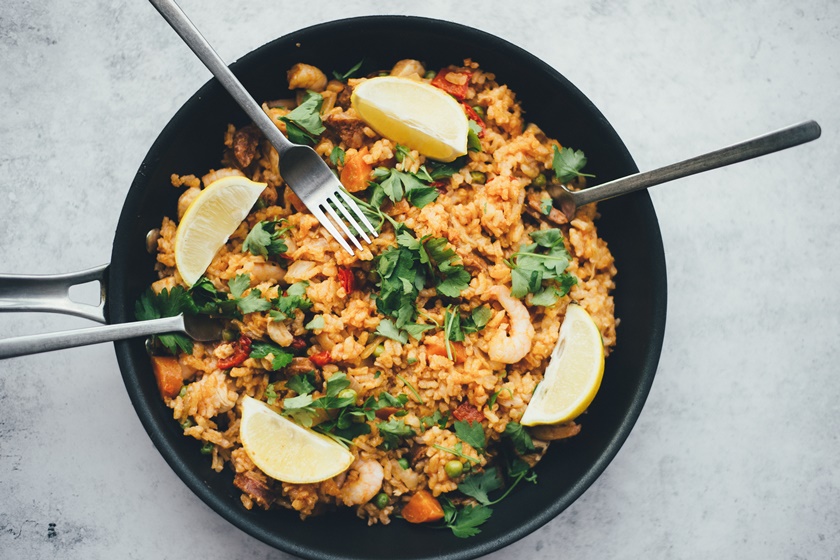
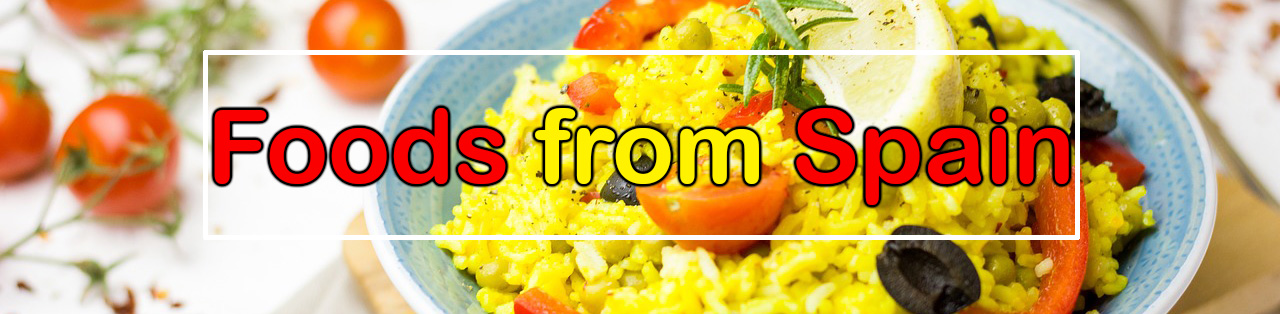
Valencian-style arroz en paella, usually known as paella, is one of Spain's most traditional recipes and one of the best-known beyond its borders. As is usually the case, it arose from people's need, not to mention curiosity, to combine the products that were at hand. A tremendous variety of paellas are made in the Valencian Community and the rest of Spain, thanks to the adaptability of rice for cooking with meat, vegetables, fish and shellfish.
In spite of the many versions that are possible, the experts consider that a really traditional Valencian-style paella should contain rice (DOP Arroz de Valencia ) of the Senia, Bahía or Bomba varieties, with pieces of chicken and rabbit, garrofós (a type of lima bean), tavellas (a local white bean) and ferraúras (a local green bean), ripe tomatoes, water, salt and saffron. First a sofrito is made in the paella, gradually adding the different ingredients, then the water. When it boils, the rice, salt and saffron are added. The heat is turned up for ten minutes, then reduced for a further ten minutes. After that, the dish should be left to stand off the heat for a few minutes.
|
Cocido features largely on winter menus in all the regions of Spain. It is a hearty, impressive dish containing pulses, vegetables and a variety of meats. Although there are many variations on the basic theme, perhaps the most popular is the Madrid-style cocido. Its basic ingredients are chickpeas, cabbage, potatoes, turnip and carrot, with chorizo, black sausage or belly pork, and veal or lamb. One of the unusual things about it is the way it is served - in three stages. It makes its first appearance as the broth in which all the ingredients were cooked together, then come the chickpeas with the vegetables and potatoes and, finally, the meat and charcuterie. Other well-known varieties, using ingredients from their local regions, are the pote gallego (from Galicia), the cocido Maragato and olla podrida (both from Castile-León), cocido montañés (Cantabria) and escudella (from Catalonia).
|
Garlic soup is one of the stars amongst traditional Spanish recipes, especially on Spain's central plateau. Of very modest origin, today it is considered a gastronomic jewel because of its simple ingredients and special flavor. All you need to make it is some day-old bread, garlic cloves, sweet pimentón (Spanish type of paprika), one egg per person, a little bit of serrano ham, salt and water. The characteristic flavor comes from the garlic and pimentón, with the egg and ham being later additions. Some of Spain's avant-garde chefs, such as Manolo de la Osa (Restaurante Las Rejas, Castile-La Mancha) and Pepe Rodríguez Rey (Restaurante El Bohío, Castile-La Mancha) have created some very personal versions of this old-style dish.
Gazpacho is one of Andalusia's traditional cold soups and one of the best-known outside Spain. The main ingredients are ripe tomatoes, which go together with smaller amounts of green pepper, cucumber, onion, day-old bread, garlic, olive oil and Sherry vinegar.
|
These are recipes, originally from Catalonia (where they are called mar i muntanya), which offer a tasty balance between meat ingredients (chicken and rabbit) and seafood (usually crayfish and shrimp). Some traditional recipes even include a touch of chocolate or almonds. This flavor combination is much-loved amongst Spanish chefs who have also created such 'surf and turf' dishes using pork or veal, shellfish such as oysters and spider crab, and fish such as squid, often in avant-garde presentations.